
The Central Park “Ruck”
Why Weighted Walking is Triggering Stubborn Heel Pain
Walk through Central Park or along the West Side Highway on a Saturday morning, and you will notice a distinct fitness trend. People aren’t just running; they are power walking while wearing heavy tactical backpacks or weighted vests.
It’s called Rucking. Praised by fitness influencers and longevity experts, rucking is the ultimate “Zone 2” cardio. It builds core strength, burns massive calories, and is generally easier on the knees than running. At our Gramercy practice, Dr. Lionel Hausman is seeing a wave of these active patients coming in with heel pain. They thought they were choosing a “low-impact” workout, but they inadvertently created the perfect storm for a chronic tendon injury.
Keep reading to learn about why the “weighted walk” is hurting your heels…and the modern technology we use to fix it.
The Physics of the “Heavy Walk”
Your feet are engineering marvels designed to absorb the shock of your natural body weight. When you walk, your foot absorbs roughly 1.5 times your body weight in impact force.
When you strap 20 to 40 pounds to your back and hit the pavement, the physics change dramatically:
- The Concrete Factor: Asphalt has a little give; concrete has zero. Every time your heel strikes the sidewalk under that extra load, the shockwave travels directly into your bones and tendons.
- The Achilles Strain: The extra weight forces your calf muscles to work overtime to stabilize your ankle. This places immense, continuous tension on the Achilles tendon, which attaches directly to the back of your heel bone.
The Warning Sign: The Red, Swollen Heel
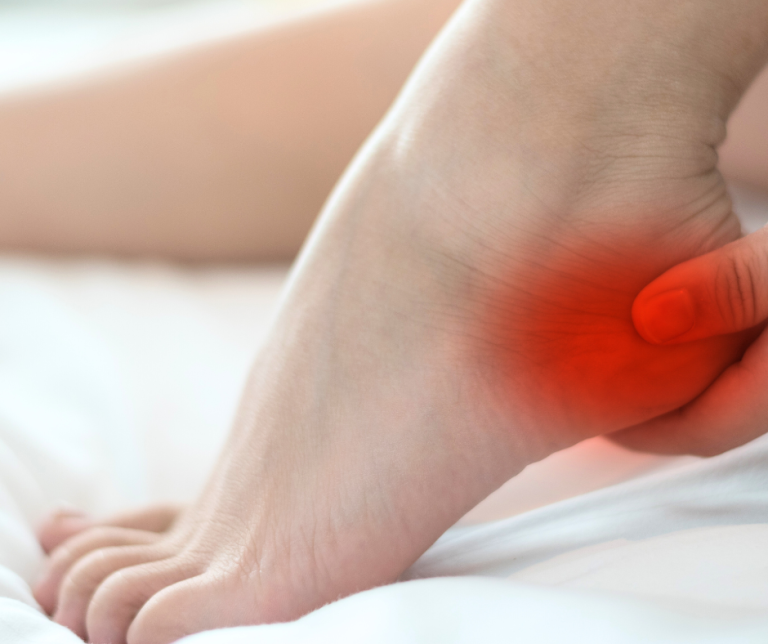
The most common fallout from this trend isn’t just general soreness; it is a highly specific, localized pain at the back of the heel.
If you are pushing through a rucking routine, you might notice a hard, bony bump forming where your shoe rubs against your Achilles. It might look angry and inflamed.
- (Are you dealing with this specific symptom right now? Read our detailed guide on why the back of your heel is red and swollento understand the mechanics of Haglund’s Deformity and Bursitis).
This combination of chronic tendon strain and bone friction creates a plateau. You try to rest for a week, but the moment you put the weighted vest back on, the pain returns.
Why “Rest” Isn’t Enough (And What Actually Works)
Tendons have a notoriously poor blood supply. Once the Achilles becomes chronically inflamed and micro-torn from heavy loads, simply “resting” often isn’t enough to trigger actual tissue repair. Additionally, New Yorkers don’t have time to spend six weeks in a walking boot. They need to stay active!
To bridge this gap, Dr. Hausman utilizes Extracorporeal Shockwave Therapy (ESWT).
Instead of masking the pain with cortisone or opting for surgical intervention, Shockwave uses high-energy acoustic sound waves directed at the damaged heel tissue.
- How it works: The sound waves create micro-trauma at the cellular level. This “tricks” your body into thinking there is a fresh injury, triggering a massive rush of new blood flow and healing factors to the stagnant tendon.
- The Benefit: It physically breaks up the scar tissue and calcification, causing the stiffness in the back of your heel.
Zero downtime. No needles. No surgery. It is the exact regenerative technology used by pro athletes to recover from tendon injuries without missing the season.
Don’t Drop the Pack Just Yet
You don’t have to quit rucking, but you do need a foundation that can handle the load.
If you are dealing with stubborn heel pain that won’t respond to ice and rest, it is time to upgrade your recovery. Contact Dr. Hausman’s Manhattan office today to see if Shockwave Therapy is the missing link in your training regimen.
If you have a foot problem you’d like to address, you’ll want to visit Gramercy Park for an appointment with Board Certified Podiatrist Lionel G. Hausman, DPM. Whether it’s an ingrown toenail, heel pain, bunions, or plantar fasciitis, Dr. Hausman can expertly treat numerous foot and ankle conditions. If you’re in need of help, get in touch with us today!